DURATION : MAY 2025
PROJECT TYPE : Product Design
PROJECT GOAL
This project aims to develop a product that makes food disposal more approachable and accessible in RISD cafeteria (The MET); moreover, school cafeterias for younger students.
Why food waste disposal?
I began this project aiming to reduce food waste in RISD’s cafeteria but found that waste is inevitable in large dining settings.
I then shifted focus to food waste disposal, an often underlooked issue. When sent to landfills, food waste emits methane, a major greenhouse gas.
Proper separation allows reuse as fertilizer, creating a more sustainable cycle of production and consumption.
PROBLEM!
“Food waste disposal feels like an additional step!”
FRUSTRATION POINTS
First year in RISD cafeteria having a food compost only bin. Students are not used to separating food waste with landfills.
Layout of different waste bins make student go back and forth to compost food waste, especially with both hands full of utensils. Busy students who are running late use landfill bins to compost food waste.
“Why does the cafeteria use this inefficient layout?”
REASONS from RISD Residential Dining Service Manager
Different waste bins locating closely can cause contamination: wrong waste going into wrong bins.
Some students might use landfill bins to compost food waste but the actual food compost bin stays clean which has better chance of getting reused in sustainable cycle.
DESIGN POINTS
Clear Indication & separation of waste bins
Change of compost area orientation
Easy disposal with one hand
Idea Development
Initial Idea of “comfort rim” waste bin.
A silicon rim to dump & bang plates with one hand.
Separating “comfort rim” from the waste bin. (Adjustable for pre-owned bins)
Addition of a scraper feature.
Compost Area Layout
Different layout drafts considering the cafeteria staff’s work radius, smooth and circular flow of students, and a water sink to wash food remains from recyclables for a better chance of recycle.
Disposal Assist Product
Adding a visual distinction from the other waste bins.
Different orientations for a sound structure.
PROTOTYPE
Dump it!
Bang it!
Scrape it!
FEATURES
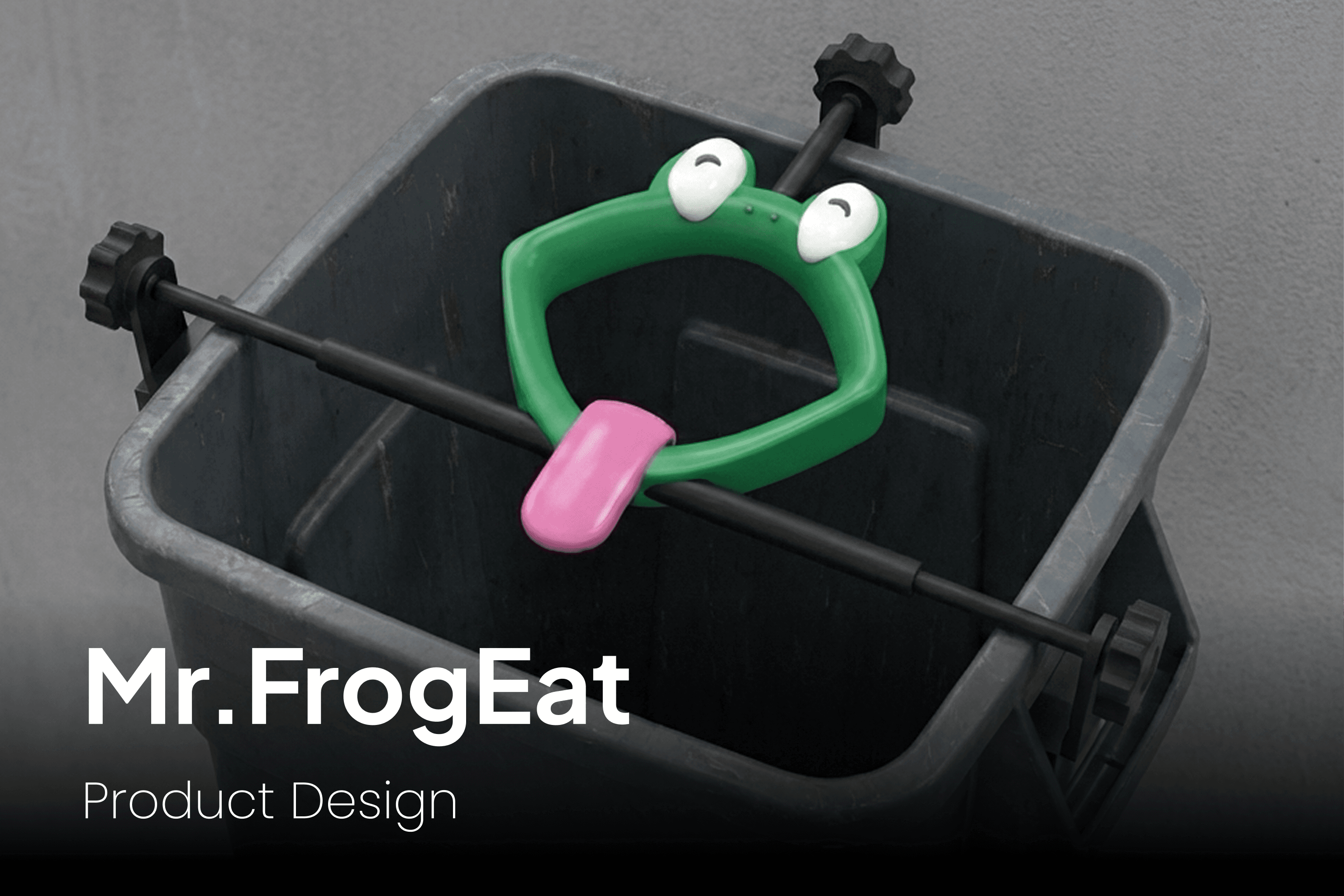
The frog’s silicone body absorbs impact as users scrape or tap their dishes to dispose of leftovers.
A flexible tongue functions as a scraper, helping remove food remnants efficiently.
Adjustable knobs allow Frogeat to attach securely to various cafeteria waste bins.
Its friendly, distinctive form clearly communicates compost disposal and reduces sorting confusion.
All components are fully disassemblable and dishwasher safe for easy maintenance.
IMPLICATION
Although the project was developed and tested within a college cafeteria context, the formation of sustainable habits begins at an early age.
I believe Mr. FrogEat has a strong potential to extend beyond the college environment, serving as an engaging and educational tool for encouraging responsible food disposal in elementary schools and beyond.
After the project presentation, RISD’s cafeteria The MET changed the layout of the compost area.
Although the food compost bin is no longer present, students are having much more fluent composting process compared to year 24-25.